
Failed Flashing Repair in Johnson City, TN
Mortar and brick drink water, and in a Tri-Cities winter the water they absorb freezes inside the wall. Where a roof membrane turns up a masonry parapet, that freezing happens directly behind the counterflashing, so each cold snap pushes a little at the joint the flashing was meant to protect, and each thaw lets a little more rain wick behind it. The sealant bead gives up first, then the termination bar loosens, and the membrane at the base of the wall pulls away from the surface it was bonded to. The first sign is usually a stain along an interior wall that looks like a plumbing issue. In Johnson City, TN, an owner who treats that stain as a sealant job usually ends up paying for wet insulation, deck repair and a rebuilt wall termination in the same year.
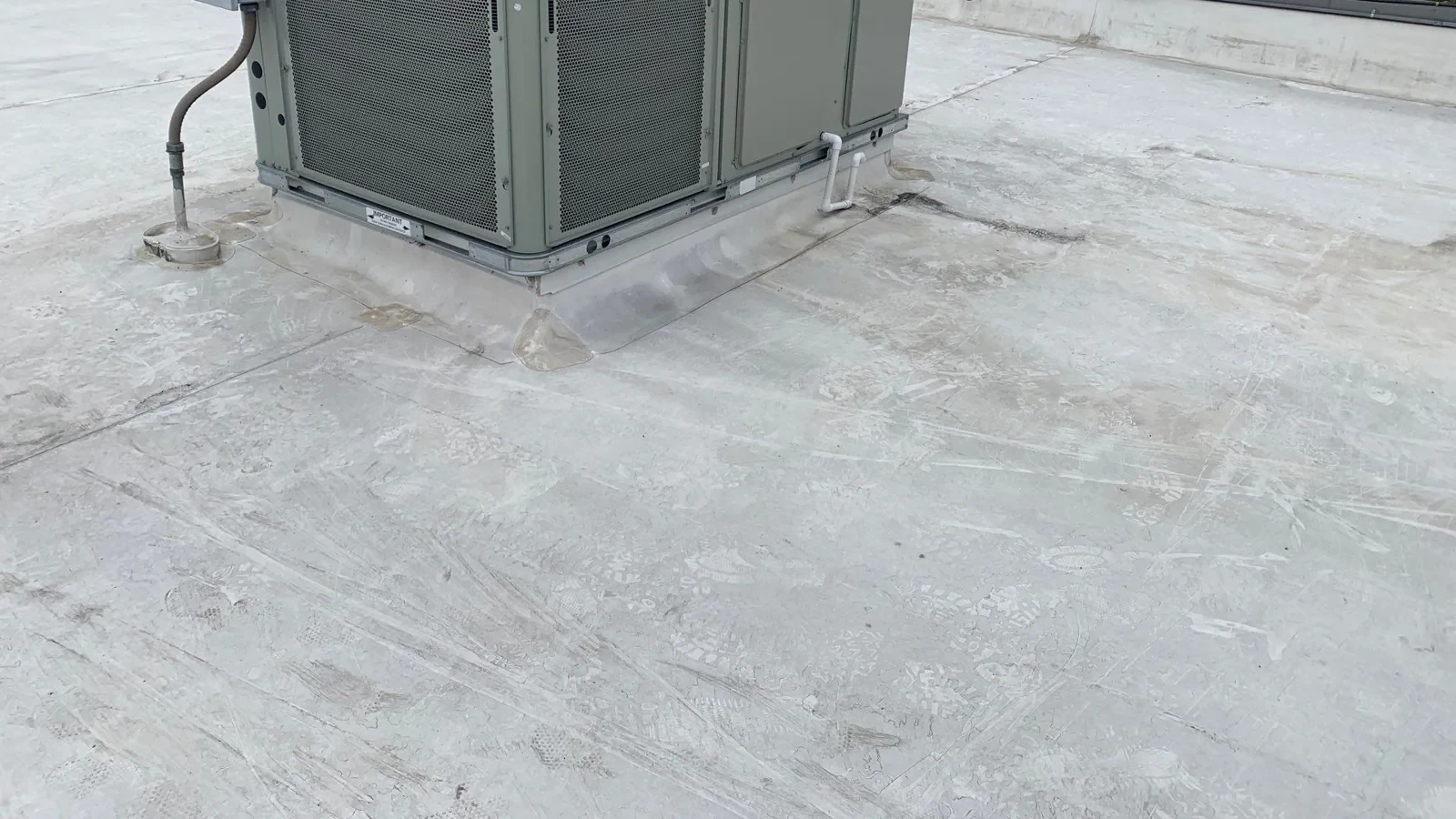
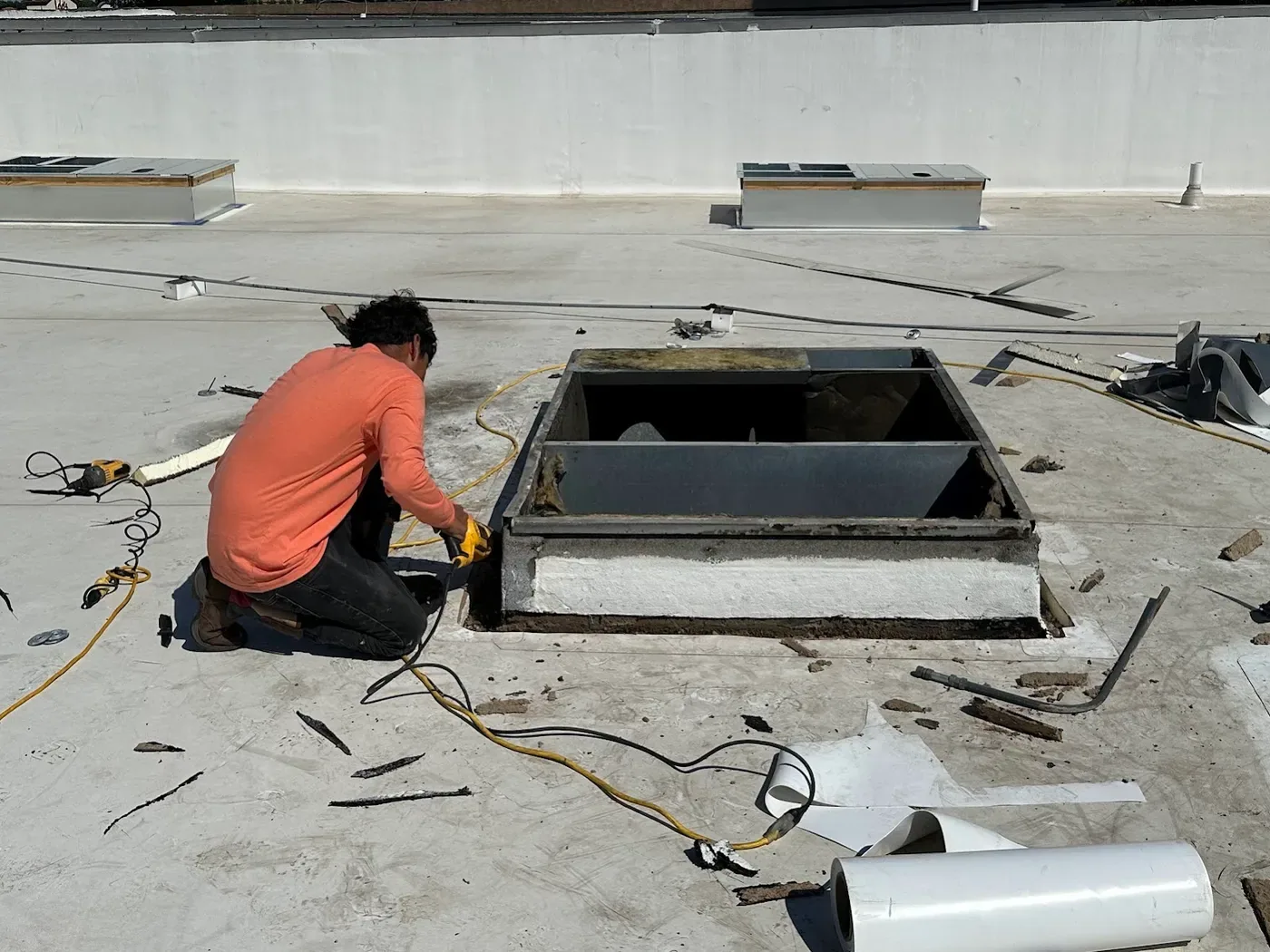
How does water get behind a flashing that still looks intact?
A flashing is a chain of small parts, and the chain fails at its weakest link rather than all at once. The base flashing is a strip of membrane or metal turned up the wall, the termination bar or reglet holds its top edge, and the counterflashing or sealant sheds water over that edge. Each part moves differently with temperature. The wall absorbs and releases moisture, the membrane shrinks as it ages, and the metal grows and contracts on a daily cycle, so the joints between them flex thousands of times a year. Sealant is the part asked to cover all of that motion, and it rarely lasts as long as the membrane it protects.
Once sealant cracks, water gets behind the flashing, runs down the back of the base sheet and finds the lap at the bottom, where the field membrane meets the vertical. A pinhole there leaks into the insulation without ever showing at the surface. That is why a flashing that looks sound from three feet away can still be the source of a persistent roof leak, and why we press, pull and probe the termination rather than judge it by eye.
Find the failed joint before the wall absorbs the cost
A flashing survey with photographs, probe results and wall moisture readings gives you an itemized list of what is failing and what is still sound. Call us to schedule it, and we will mark each joint as a seal-up, a reflash or a wall repair.
What do we pull, probe and press at a flashing inspection?
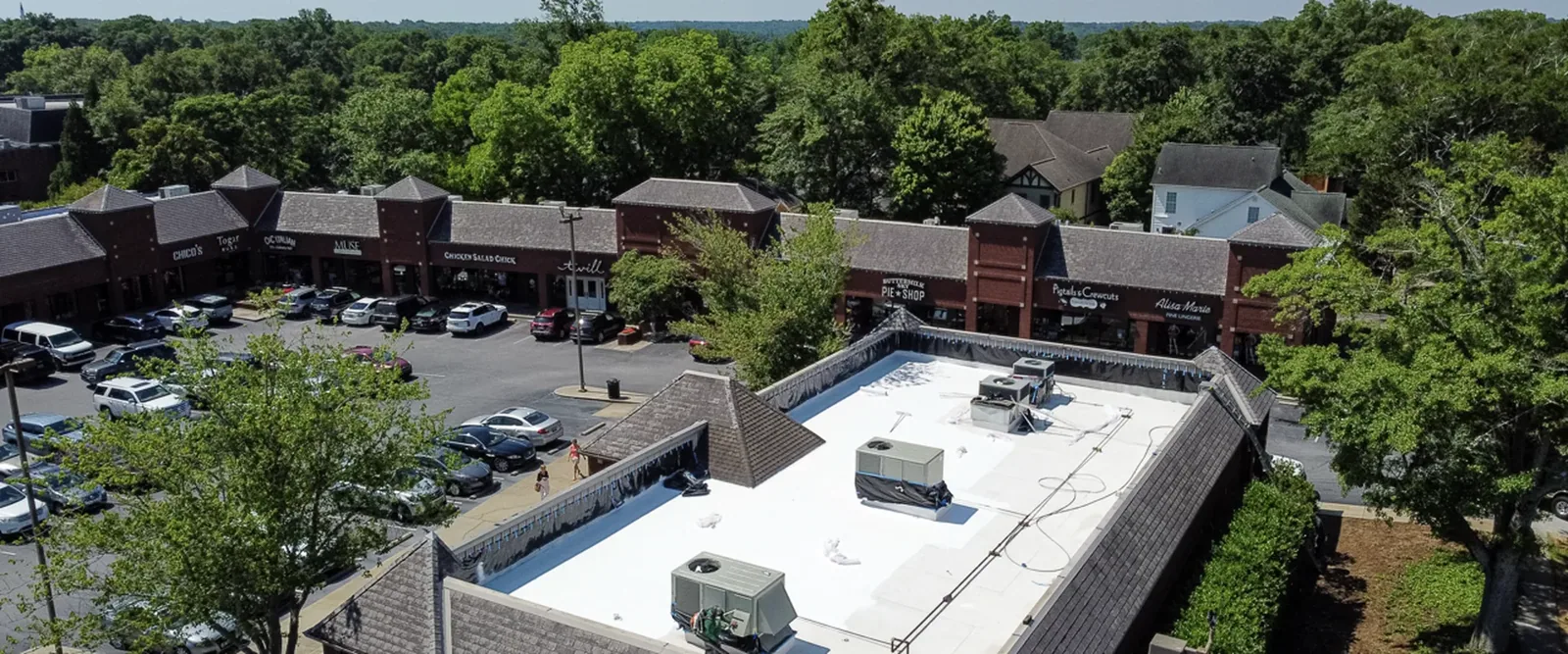
We start at the top edge. Is the termination bar fastened at a consistent spacing, and does the sealant bead still bond to both surfaces, or does it lift away from the masonry like old tape? Then the vertical: is the membrane tight to the wall, or does it bridge at the corner and stand off by an inch? At the base, we run a probe along the lap to find the soft or open section, and we check every inside and outside corner, where folded or patched membrane can conceal a small opening. At penetrations and curbs we look for cracked boots, pitch pockets that have shrunk, and clamps that have loosened. We also read the wall, since spalled mortar joints and cracked brick above the flashing admit water that no sealant will keep out. Photographs mark each failure on a roof plan so the repair location can be found again.
Which Johnson City buildings put the most stress on a wall-to-roof joint?
The masonry buildings of downtown Johnson City test flashing where old brick meets the roof. The State of Franklin Corridor connects downtown to ETSU through commercial, office, education and housing uses; Boones Creek connects to I-26, US 11E and US 321. At each property, map the parapet runs and note wall condition before selecting a termination. Older mortar can absorb water, while additions may use different substrates, so the same sealant detail should not be assumed across a multi-section roof.
Climate adds the second layer. Winter lows in Johnson City average about 25 degrees Fahrenheit, and the city sees roughly 15.6 inches of snow a year, so a wall-to-roof joint cycles through freezing and thawing many times in a season. The 2018 International Existing Building Code, which the city has adopted, governs how repairs to existing buildings are done, and it is one more reason to document a flashing repair with the same care as a replacement.

Reseal, reflash or rebuild the termination?
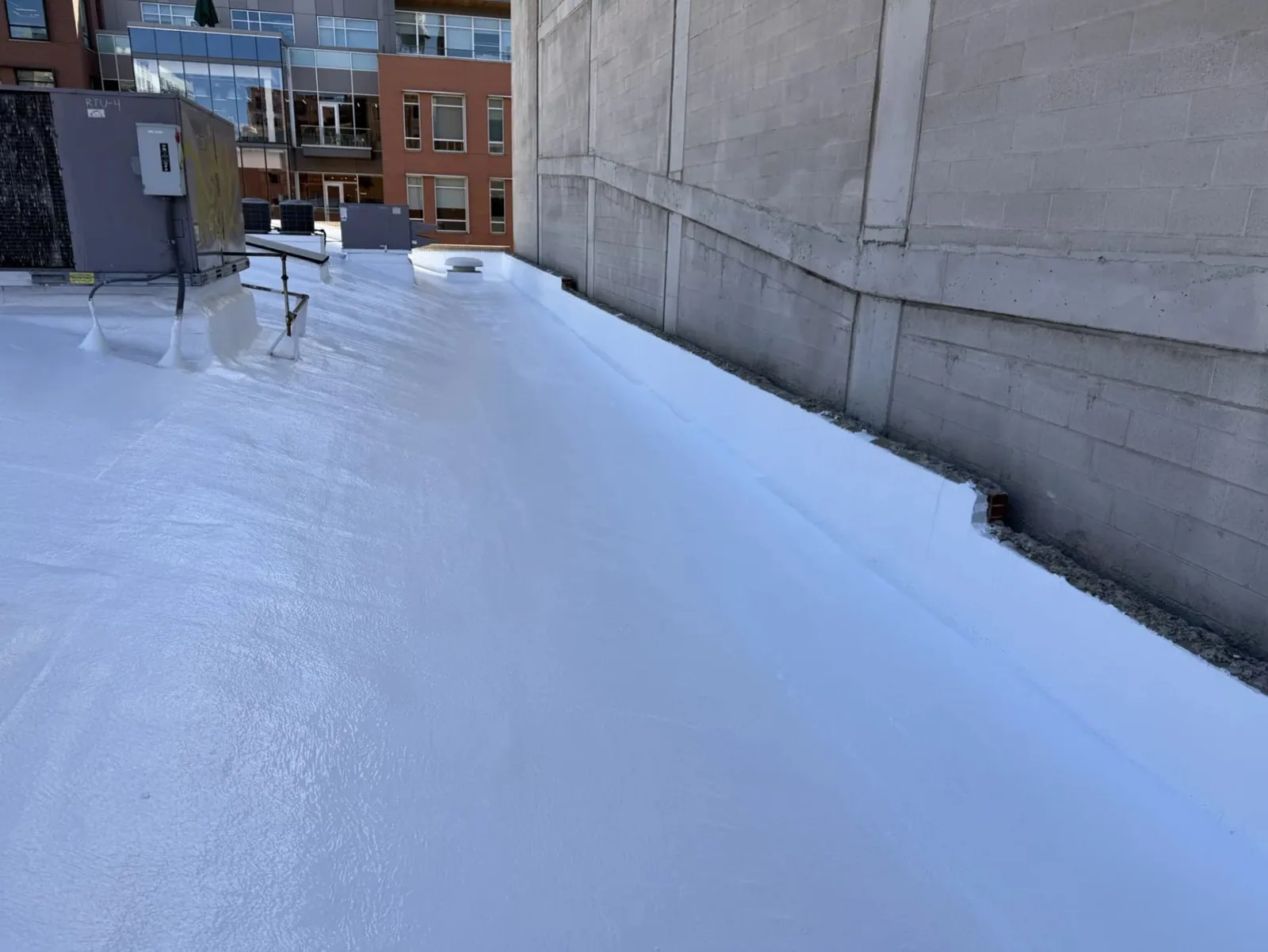
A bead of sealant renews the top edge for a season or two and nothing more, so it makes sense only where the base flashing is sound and the wall behind it is dry. When the flashing membrane has shrunk, split at a corner or lost its bond, the repair is a new base flashing tied into the field sheet with a proper lap, finished with a new termination bar and counterflashing. Where the wall itself is the problem, with failed mortar, a cracked coping stone or a parapet that has taken on water, the work begins with masonry repointing and the flashing follows it. On a bituminous roof, such as modified bitumen, the flashing plies need to be tied into the existing layers rather than overlaid. Penetrations get the same treatment, whether that means a new boot, a rebuilt curb flashing, or fresh skylight and penetration flashing. We price each location separately so a good corner is not replaced to match a bad one.
What does a failed flashing cost the wall as well as the ceiling?
The ceiling stain is the least expensive part of a flashing failure. Water that enters at a wall termination runs down inside the wall cavity, wets the insulation and the interior finishes, and freezes in the masonry on cold nights, where it spalls the brick face and opens the mortar joints that the flashing was supposed to protect. The loop is self-reinforcing, since a damaged wall admits more water to the next flashing. Meanwhile, the roof insulation along the wall absorbs water and loses thermal value, and the steel deck beneath it begins to corrode. Repairing the flashing in the first season costs a fraction of the combined masonry, insulation and interior work that follow a winter or two of leaking. Edges and equipment supports share the same pattern, which is why we look at coping and edge metal and equipment curbs on the same visit.
A split that continues beyond the flashing line should be scoped as seam failure repair, with the termination detail corrected at the same time.
If water remains after the flashing is corrected, check drainage and slope before closing the work order; ponding-water repair addresses that separate cause.
Commercial Roofing Questions
Why does the leak return at the same corner after the sealant is renewed?
Sealant covers the symptom at the top edge, but corners are folded or patched membrane, and the weak lap underneath keeps passing water. Until the base flashing is rebuilt at that corner, new sealant simply hides the path for a few months.
Can a flashing fail while the field of the roof is in good shape?
Frequently. The field membrane is a continuous sheet with few moving parts, while flashings carry joints, terminations and sealant that all age faster. It is common to find a sound field with a worn perimeter, and that case is repaired locally rather than replaced.
What should be checked before flashing is replaced along an old masonry wall?
The wall comes first. Loose mortar, cracked coping stones and a saturated parapet need repair before new flashing goes on, or the new work fails for the old reason. Moisture readings in the wall and a look at the joints above the flashing show whether masonry work belongs in the scope.
How is flashing repair handled on a campus where the buildings are protected?
Work on a historic building is planned to keep as much original fabric as possible. That means conservative cutting, reversible fastening where the owner requires it, and materials that match the profile of what is there. The owner's preservation requirements are confirmed before a price is set.
Which part of a flashing repair carries the most cost?
Access and wall condition move the price more than the flashing material does. A termination along a long, tall parapet needs staging or a lift and careful masonry work, while a curb or boot on a low roof is quick. Pricing each location separately shows where the money goes.
Related Roofing Pages
Commercial Roof Leak Repair
How the work is scoped, phased and documented on Tri-Cities roofs.
Downtown Johnson City
What we check, what we recommend and how the crew keeps the building running.
Interstate 26 Corridor
Conditions, options and next steps for commercial buildings in East Tennessee.